 |  | Cracking sick jokes
(Filed: 29/11/2004) |

 What is multiple sclerosis? What is multiple sclerosis?
Comedian
Jim Sweeney is used to making people laugh, but his one-man show, about
his MS, has been making audiences cry, too, he tells Bryony Gordon Jim
Sweeney is used to making people cry with laughter. As one sixth of the
Comedy Store Players – the improvisation group that also counts Paul
Merton as a member – the award-winning comedian has done just that for
the 19 years that they have been performing. But Sweeney is not used to
making his audience cry tears of sorrow. When he took a new one-man
show to the Edinburgh Festival this summer, that was how some of the
crowd reacted. | | 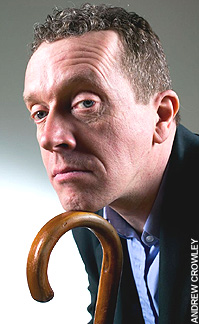 | | 'My balance is just non-existent. I wobble all the time' |
This is perhaps not surprising when you learn that the 49-year-old's
show, My MS and Me, is about the condition from which he has suffered
for almost 20 years. But Sweeney never intended it to be moving, only
amusing. That's why the show's opening song is Elvis Costello's I Can't
Stand up for Falling Down. My MS and Me won rave
reviews and will be broadcast on Radio 4 in the New Year. There are
even suggestions that it will be made into a book. All of which seems
to have surprised Sweeney. "All the way through
rehearsals, I kept saying to my director: 'Is this boring you?'" he
says, when we meet for lunch. "It wasn't until I saw the reviews and
the reactions of the audiences that I realised there were bits that
people found incredibly touching. There's a section of the show that
seems to really get them. It touches on a time when I fell over one
night and couldn't get up. "I was lying on the
floor for quite a long time and like anybody who is awake at 3am, there
were all these thoughts going through my head, like, 'I'm going to
spend the rest of my life lying here on the floor'. Which, of course, I
wasn't, but you know." I don't know, but this is
typical of Sweeney. He plays down his multiple sclerosis throughout our
conversation. He seems to be the kind of chap who just wants to get on
with life. "It was very strange to have people in
the audience fighting back tears. And I thought, 'Oh, it's not my
fault, I was just telling you about my thing'." His
"thing" has, in the past few years, left him almost unable to walk. The
left side of his body is the worst, but he thinks his right side is
gradually catching up. "My balance is just
non-existent. I wobble all the time. But the thing is, when I'm sitting
down, nobody knows about the MS," he laughs. "I can give everyone a
show when we get up." He uses a walking stick, but it is obvious that he is struggling. He has a wheelchair but is reluctant to use it. "It
is really only a matter of time before I have to start," he says. "I
was thinking this morning that I should take it out today, because I've
never been to this restaurant before. But for various stupid reasons,
I'm holding out until next year. Then, it will have been 20 years, and
also I think it's really important to keep walking until I absolutely
can't any more." His vision has also been
affected. "Your head is a black dot," he says to me, covering his left
eye with his hand. "Otherwise, it's just blurred. Short-sighted people
understand. It's like when you take your glasses off for a moment and
everything shifts into a nice, comforting blur. Well, my vision is like
that all the time."
Living with MS means that he also has to "live under a kind of
benevolent house arrest", he says. "But I don't really mind. I've done
so many things. I've stood on the Great Wall of China and walked
through Tiananmen Square." To get about, he takes taxis. "They're
tax-deductable now," he says, cheerily. When I
tell him that he seems remarkably relaxed about his condition, he is
defiant. "I could spend hours wallowing in self-pity but, absolutely
genuinely, what's the point in me doing that? I do have moments. I was
watching a programme about space travel a few nights ago, and I thought
'I'm never going to be the one they pick'. And then I thought, 'well,
nobody is!'" He doesn't take prescribed drugs for
MS. "The doctors could only offer me steroids and I didn't want to look
like an East German shot-putter," he says. But, like many MS sufferers,
he does smoke cannabis. "It relaxes my leg. Every night, I have a third
of a pure cannabis joint." Sweeney wishes it was
legal. "It's ludicrous for a man of my age to be sidling up to people
in pubs asking for dope. After one show in Edinburgh, a woman who was
suffering from MS came up to me and the first thing she said was:
'Where can I get grass?' "I do resent the fact that
there will never be a proper discussion about it, because people buy
into the tabloid mentality that if you smoke dope, you'll end up
injecting heroin. That's as stupid as claiming that if you drink a half
pint of bitter, you'll end up on meths. It's only a gateway drug for
the predisposed." Does he worry that one day, he
will no longer be able to perform as a Comedy Store Player? The show,
which is entirely improvised, can get quite physical. "I've
been thinking about this a lot," he says. "Tiredness can hit me about
halfway through the second half. Three years ago, I brought it up with
the others. I told them, 'It may get to a stage when I can't stand to
perform any more, and I think I'll know when that happens, but if I
don't, please tell me.' They all looked at me with blank faces and
said: 'Well, we'll get a wheelchair, obviously', and then carried on
with the conversation. "They are typical boys in
that they just do things beautifully for me without any fuss – one of
them always walks behind me on stairs to make sure I don't stumble, and
there's always someone outside the venue to walk me to the pub. There
may well be a point when I feel I can't do it any more, but it's not
now." The only thing that bothers Sweeney is that
the onset of MS coincided with the birth of his first daughter (he has
two daughters, aged 18 and 19, with his girlfriend, Carol). "I think
that the wickedest and most devious thing about MS is that it tends to
hit at around 30, when people start having kids."
Sweeney, of course, does not allow himself to become too negative. "I'm
lucky because it has only crept up properly over the last five years,
and I'm sure my daughters weren't aware of it as children. I almost
certainly wasn't. I just carried on with my life."
And with that, our lunch is over. We spend a while looking for a
waitress to ask for the bill. "Shall we just make a run for it?"
suggests Sweeney, before pausing for a moment. He looks at his walking
stick and back at me, and begins to laugh. "We wouldn't get very far,
would we?" The Comedy Store Players perform at London's Comedy Store on Wednesdays and Sundays. For tickets, tel: 0870 060 2340, or see: www.comedystoreplayers.comWhat is multiple sclerosis? Multiple
Sclerosis affects the central nervous system. It is an auto-immune
condition, in which the immune system attacks myelin, the protective
sheath that surrounds nerve fibres. When the myelin is damaged,
messages cannot travel along nerve fibres as effectively. What are the symptoms? Symptoms
can include overwhelming tiredness, difficulty walking, trouble with
vision, dizziness, memory problems, slurring speech, stiffness and
spasms, depression and mood swings. There are four
types of MS. The most common is relapsing-remitting MS. This is
characterised by a relapse or flare-up of symptoms followed by a period
of recovery. Most people who have this form later develop secondary
progressive MS, in which the disability progresses for six months or
more, whether the relapses continue or not. The
other main type is primary progressive MS, where symptoms steadily
worsen, without distinct relapses and remissions. Some people may also
be described as having benign MS, if they have experienced little or no
disability for 10 to 15 years. How many are affected? There
are 85,000 sufferers in the UK. It is the most common disabling
neurological disease in young adults, affecting twice as many women as
men. The condition is not hereditary, although the risk of developing
symptoms is slightly higher if a relative has the condition. How can MS be treated? Nobody
knows what causes MS, and there is no cure. Sufferers can take
disease-modifying drugs, which reduce the severity of relapses. Many
sufferers claim that cannabis helps symptoms. The Multiple Sclerosis Society, tel: 0808 800 8000, or see www.mssociety.org.uk Publishers wishing to reproduce photographs on this page should phone 44 (0) 207 538 7505 or e-mail syndication@telegraph.co.uk
Next story: Everyone's asking for seconds
|


